
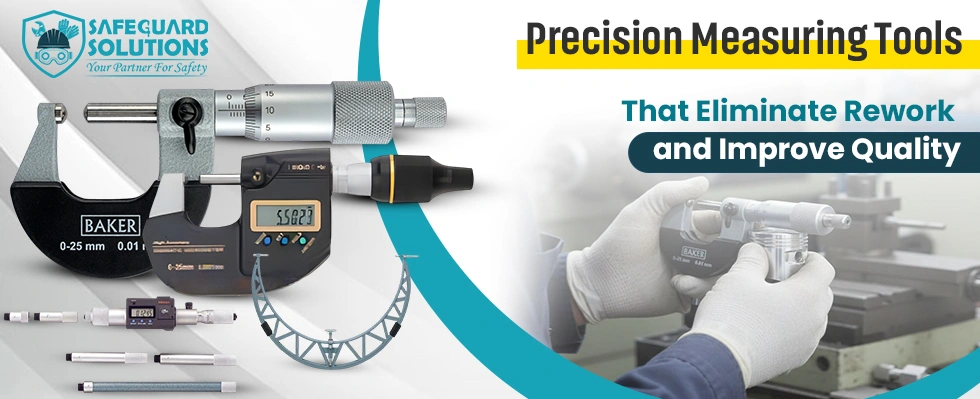
Buying Guide For Micrometers To Reduce Rework In Industrial Applications
In every machining unit, dimensional control defines production stability. When measurement is consistent,
- Assembly runs smoothly,
- Batch acceptance improves, and
- Production schedules stay on track
Micrometers sit at the center of that control. These are verification instruments that confirm whether machining output matches design intent.
In manufacturing environments, where cost efficiency and delivery commitments are closely monitored, the right micrometer is a critical investment.
Measurement accuracy directly influences rejection rates, machine settings, and overall production efficiency.
Accurate Measurement Is Directly Proportional To Stability
In automotive component plants, pump manufacturing units, fabrication shops, and MSME machining centers, dimensional control affects every downstream process.
Imagine you have a metal rod that needs to fit inside a hole. The drawing specifies that the rod should be 20.00 mm in diameter, with only a small allowed variation. To verify such tight tolerances, operators typically rely on a precision micrometer, a highly accurate precision measuring instrument designed for critical dimensional inspection.
Now suppose the rod is slightly bigger — maybe 20.02 mm. It might still look acceptable if measured casually or checked using a low-accuracy device instead of an industrial micrometer or a calibrated measuring micrometer tool. Individually, that rod may not appear problematic.
However, when the rod is inserted into the matching hole, the fit becomes tight. The operator may need to apply additional force. In automated assembly systems, the machine may struggle to complete insertion. Over time, this interference fit can create excess friction, accelerated wear, higher energy consumption, or even component rejection.
This is where accurate measurement becomes critical. Using an external micrometer or a properly calibrated micrometer screw gauge allows operators to detect even micron-level deviations before parts move downstream in production.
Now comes the real issue.
If the production team does not realize that the rod is slightly oversized due to improper measurement practices, they may assume another factor is causing the problem. They might believe the cutting tool is worn out or that machine alignment is incorrect. As a result, they may unnecessarily adjust machine parameters such as speed, feed rate, or tooling setup — unintentionally introducing additional variation into the manufacturing process.
Using precision instruments sourced from a reliable Micrometer Supplier helps manufacturers detect even minute dimensional deviations early in production. Accurate micrometer measurements ensure components stay within tolerance, preventing assembly issues, reducing rework, and maintaining consistent product quality.
In precision manufacturing, small measurement errors can quickly turn into large production problems — making dependable measurement tools an essential part of quality control.
Gradually, the entire production line starts moving away from the original design size. This is called “drift.”
So the problem is not theoretical. Small measurement errors at the beginning can create real assembly and production issues later. That is why accurate micrometer measurement matters.
How The Right Micrometer Can Solve Such Issues?
When inspection tools are correctly selected and maintained, deviations are caught early, which prevents cumulative error across batches.
The situation described above does not start at the assembly station but at inspection.
When the correct micrometer is selected and used properly, small dimensional deviations are detected immediately.
- That 20.02 mm shaft is identified before it reaches assembly.
- The operator does not need to guess.
- The machine does not need unnecessary adjustments.
- Production remains controlled.
The right micrometer solves issues in three practical ways.
1. It Detects Deviation at Source
A micrometer with suitable resolution and accuracy will clearly show whether a part is within tolerance or drifting toward the upper or lower limit.
For example:
- If the tolerance is ±0.02 mm, a micrometer with 0.01 mm resolution may show rounding ambiguity.
- A 0.001 mm resolution micrometer gives clearer insight into how close the dimension is to the limit.
This allows corrective action before an entire batch crosses tolerance limits.
2. It Prevents Unnecessary Machine Adjustments
When measurement is uncertain, machine operators tend to compensate based on assumption. Offsets are changed. Tools are replaced prematurely. Process parameters are altered.
With a reliable micrometer:
- The measurement confirms whether the dimension is actually out of tolerance.
- Adjustments are based on data, not assumption, thus improving machine stability
This reduces what is often called “process drift.”
3. It Maintains Fit Consistency in Assembly
In industries such as automotive, pumps, and gear manufacturing, dimensional relationships define performance.
Shaft-to-bore fit, bearing seating, and housing alignment all depend on precise measurement. When micrometers provide consistent readings:
- Interference fits remain controlled.
- Clearance fits remain functional.
- Assembly resistance does not fluctuate.
That translates directly into lower rejection rates and smoother production flow.

Selecting the Correct Micrometer for Your Application
Solving rework issues is not about simply purchasing a micrometer. It is about selecting the correct type and specification.
Match Measuring Range to Part Size
Using a 0–25 mm micrometer for parts that frequently approach 25 mm limits introduces risk. Always choose a range that comfortably covers expected production variation.
Choose Accuracy Based on Tolerance
If your part tolerance is tight, your measuring tool must be tighter.
A practical rule in industrial metrology is that measurement uncertainty should be significantly smaller than the part tolerance. Otherwise, you are measuring uncertainty instead of dimension.
Consider Resolution Carefully
- 0.01 mm is adequate for general machining.
- 0.001 mm is required for precision automotive, aerospace, or tool room components.
Higher resolution supports better trend monitoring during production.
Evaluate Frame Stability and Measuring Faces
For larger micrometers, frame rigidity matters. Any flex during measurement introduces variation. Carbide measuring faces improve durability and reduce wear over time.
Digital vs Mechanical
Digital micrometers reduce human reading error and support easier data recording. On the other hand, mechanical micrometers are robust and require minimal electronic dependency.
Your selection should align with inspection frequency and documentation needs.
Ensuring Discipline, Control, and Production Stability
Our experts at Safeguard Solutions opine that even the correct micrometer will not deliver reliable results without proper handling discipline.
- Calibration intervals must be followed as per the quality plan.
- Zero error should be verified before use.
- Measuring faces must remain clean, and
- Instruments should be stored securely to prevent damage or contamination.
Measurement reliability depends as much on usage practice as on tool specification.
When the micrometer is correctly selected for range, accuracy, and application, and maintained with discipline, it becomes a control point within the manufacturing process.
If you want to know more about our precision measuring instruments, feel free to connect anytime. We’d be happy to give you clarity on what micrometers or other tools to use specifically for your kind of project.
Categories
Recent Posts
- Corded Vs Cordless Power Tools For Industrial Applications
- Selecting The Right Hydraulics Tools Supplier For Your Industrial Power Pack
- Buying Guide For Micrometers To Reduce Rework In Industrial Applications
- Manual Vs Digital Window Tint Meter – Which Is More Accurate For Compliance?
- How Fire Suppression Tools Are Transforming Real-Time Protection In 2026


