
Corded Vs Cordless Power Tools For Industrial Applications
If you spend enough time in a fabrication shop, this debate comes up sooner or later. Someone complains about corded grinders because “they never slow down.” Someone else refuses to go back to cables after using cordless tools on site.
The truth is, both have their place. The better choice depends on the kind of work you’re doing, how your shop is set up, and how long the tool needs to run without a break.
As a power tools supplier, we at Safeguard Solutions look at it the way a fabrication team would.
When Corded Tools Work Just Right
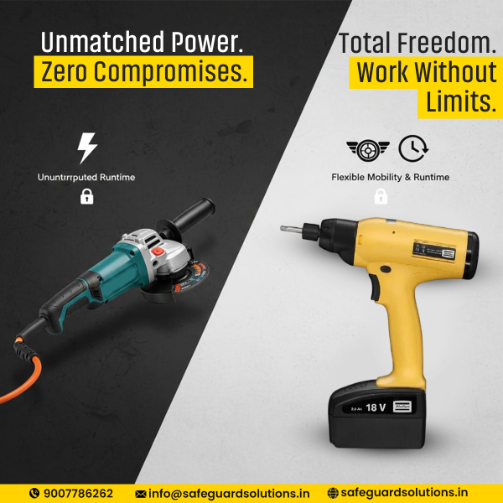
If your day involves long hours of cutting, grinding, or heavy drilling at a fixed workstation, corded tools are hard to beat.
- They deliver steady power from start to finish.
- There is no drop in performance because of the low battery.
If you are cutting thick MS plates or running a grinder continuously to prep weld edges, that consistency matters.
Corded tools are also straightforward.
- Plug in, switch on, and work.
- No battery rotation.
- No charging schedule.
For production environments where machines are running for extended periods, this simplicity is practical.
However, there are downsides as well. For example, the cables restrict free movement. In a crowded shop with multiple operators, extension cords can get in the way if not managed properly.
Where Cordless Power Tools Win Effectively
Now imagine working on a large fabricated frame. Or climbing a structure for installation. Or moving around a site where power points are limited.
This is where cordless tools are non-negotiable.
- No cables to drag around.
- No searching for sockets.
You can grab the drill or impact driver and move freely. For quick jobs, adjustments, tack weld prep, or installation work, cordless tools save time simply because they remove small inconveniences.
Modern battery platforms are strong enough for most everyday fabrication tasks. Drilling structural sections, fastening brackets, light to medium grinding, even metal cutting in controlled cycles. For many such shops, cordless tools are primary tools and not backup options.
But they do need constant management –
- Batteries must be charged.
- Spare packs must be available.
If that system is not organized, productivity drops.
Decide Based On How Your Shop Works
There is no ‘which is better’ consideration when selecting a corded or cordless power tool. The real question is how your workflow runs and what type of system will suit its primary purpose.
If you have fixed cutting stations and heavy continuous grinding, corded tools provide reliability and stable output.
If your team moves between bays, handles installations, or works on larger assemblies where access changes constantly, cordless tools reduce friction in daily operations.
In reality, most fabrication shops end up using both. So for them, corded tools handle the long, demanding jobs, while cordless ones handle mobility and quick turnaround tasks.
What Specifications Should You Look For?
Being a renowned power tools supplier, we understand that these you cannot decide solely based on cords or cordless features. The real decision lies in the specifications that affect daily performance on the shop floor.
Here are the specifications that should influence your decision:
- Motor Power or Voltage - For corded tools, check the wattage. If it’s higher, the tool can handle tougher materials and longer running periods. For cordless ones, voltage gives you a rough idea of power capacity. An 18V or 20V platform is common for fabrication work, but the application should guide the choice.
- RPM and Speed Control - Grinding, cutting, and drilling require different speeds. Look at the no load RPM and whether the tool offers variable speed control. Controlled speed helps maintain accuracy and reduces wear on consumables.
- Torque Output - For drills and impact drivers, higher torque is useful for structural fastening, thicker materials, and stubborn bolts. Make sure the torque range matches your typical applications.
- Duty Rating and Build Quality - Fabrication is not light duty work. The tools should have robust housings, quality bearings, and proper cooling. Continuous or heavy duty rated tools last longer in demanding environments.
- Battery Capacity and Charging Time - If you are considering cordless tools, battery amp hour rating directly affects runtime. Higher Ah means longer operation between charges. Also check charging time and whether fast chargers are available.
- Ergonomics and Handling - A tool used for hours must be comfortable at all costs. Grip design, balance, and overall weight affect operator fatigue. Over time, this influences productivity and even safety.
- Availability of Spare Parts and Service Support - Even the best tools require maintenance. Access to service support and spare parts should be part of your decision, especially for shops that rely heavily on daily tool usage.
Final Thoughts
In fabrication shops, power tools are used as daily working equipment. You should select one based on performance specifications rather than just corded or cordless preferences.
At Safeguard Solutions, we focus on understanding how your team works before recommending any equipment. As a power tools supplying company, we look at:
- The type of materials you handle,
- The average running time of tools,
- Whether the work is station-based or mobile, and
- How demanding the applications are.
We make sure that the tool you choose should fit naturally into your workflow, improve efficiency, and withstand daily industrial use without becoming a weak link in your process.
Categories
Recent Posts
- Corded Vs Cordless Power Tools For Industrial Applications
- Selecting The Right Hydraulics Tools Supplier For Your Industrial Power Pack
- Buying Guide For Micrometers To Reduce Rework In Industrial Applications
- Manual Vs Digital Window Tint Meter – Which Is More Accurate For Compliance?
- How Fire Suppression Tools Are Transforming Real-Time Protection In 2026


