
Manual Vs Digital Window Tint Meter – Which Is More Accurate For Compliance?
Firstly, we need to understand that tint inspection is not a matter of visuals but a regulatory obligation. Under Indian regulations, every vehicle glass must meet prescribed VLT limits to ensure driver visibility and road safety. A subjective assessment cannot verify whether a windshield transmits 70% light or whether side glass meets the required 50% threshold.
Only calibrated instrumentation, like an advanced car Window Tint Meter can.
Of course you can inspect vehicle glass tinting manually using your experience. However, it seldom generates a numeric output, which is integral for compliance.
Why Manual Tint Checking Falls Short Of Necessities?
Most manual checks involve visual assessment, shade cards, or installer judgement based on prior experience. While this approach may appear practical on site, it lacks measurement control and accurate repeatability.
Visible Light Transmission, or VLT, is simply the percentage of visible light that passes through the glass window of any vehicle. When you check tint manually, you are not measuring how much light actually passes through the glass but judging how dark it looks.
That judgement is variable. For example, the same window may appear darker in the evening than in direct sunlight. The viewing angle, the thickness of the glass, and even the interior seat color can influence how the tint appears in the naked eye. Hence, two inspectors may have different perceptions while looking at the same glass in different situations.
Then there is also the issue of documentation. RTO inspections require objective proof that the vehicle complies with prescribed VLT limits. Without a numerical reading, there is no formal record to present during verification.
If you run a workshop involved in vehicle approvals or fleet deliveries, relying on visual estimation alone can be risky. Like, if a car fails inspection due to incorrect tint levels, accountability often falls on the installer or testing center.
Digital Window Tint Meter Benefits
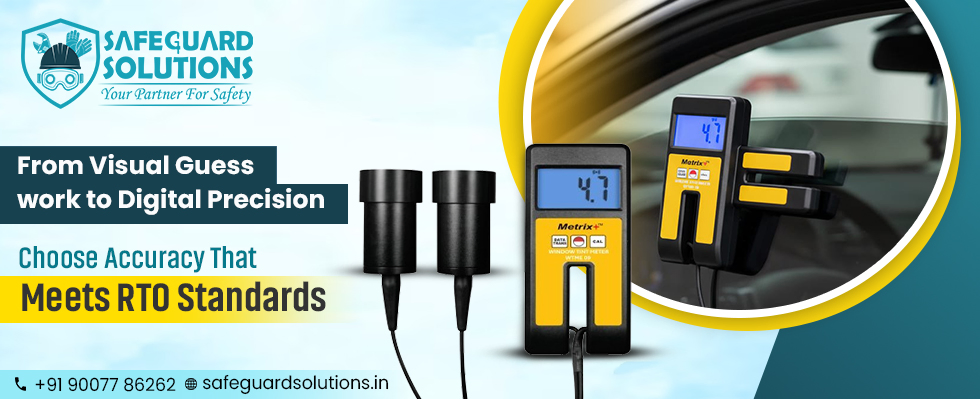
Advanced digital window tint meters work scientifically. Using optical transmission principles, these systems emit controlled light through the glass and measure the percentage transmitted. The result is displayed instantly as an accurate VLT value.
Besides giving accurate VLT readings, our range of window tint meters at Safeguard Solutions comply with international standards like ASTM D1033-61 and JIS K7105-81.
You can expect the following benefits with its digital operation:
- The range of measurement lies between 0-100%
- It gives proper resolution up to 0.1%
- ±2 % reduces the chances of compliance errors
- The process of checking is non-destructive to the glass
- Record keeping possible with Bluetooth data transfer features
With such an instrument, you can guarantee that the inspection is accurate, consistent, repeatable and compliant with the RTO norms.

Functional Benefits Beyond Automotives
Digital window tint meters are not only useful in the automotive industry but also in construction and various commercial and security applications.
For example,
- In construction, they validate light transmission to support energy efficiency targets and thermal performance standards.
- In commercial spaces, they help control glare, UV exposure of facilities and improve indoor comfort.
- In security applications, these instruments often confirm that tinted glass balances privacy with surveillance visibility.
The Best Tint Meter For Surveillance And Compliance
You should always select a professional tint meter with accuracy, compliance, repeatability and record keeping features.
Our range of highly-capable digital window tint meters are suitable for all kinds of field inspections, automotive workshops, and compliance centers across India. One thing is certain.
Whichever model you choose, one thing is for certain. Manual checking is subjective and lacks authenticity, while digital instruments give quantitative results that are repeatable and reliable across varying conditions.
Do you need more specifications of our product? Get in touch with us directly so we can give you a complete spec sheet for your easy reference.
Categories
Recent Posts
- Corded Vs Cordless Power Tools For Industrial Applications
- Selecting The Right Hydraulics Tools Supplier For Your Industrial Power Pack
- Buying Guide For Micrometers To Reduce Rework In Industrial Applications
- Manual Vs Digital Window Tint Meter – Which Is More Accurate For Compliance?
- How Fire Suppression Tools Are Transforming Real-Time Protection In 2026


