
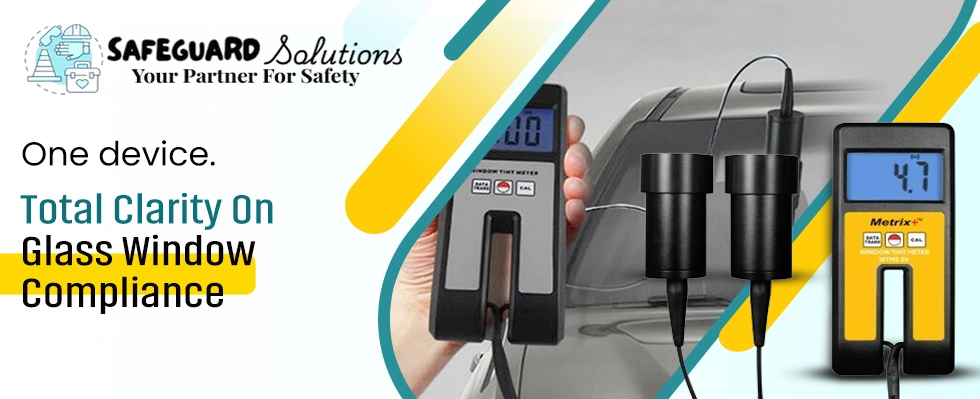
Measure Your Window Transparency Accurately And Stay Compliant Always
The inspection environment of today is stricter than ever, be it traffic rules or simply window tinting. It doesn’t matter whether you’re operating a small workshop, an RTO, PUC, or a car detailing centre, the rules are the same for everybody.
You need a reliable and efficient way to measure the transparency of your glass panes. And that’s where our window tint meter comes to your rescue. If one tool can ensure compliance, customer trust and clarity, what’s the need to employ alternative expensive measures?
But the main problem does not exist in the reliability or innovation of the new technologies. It’s in awareness. If the workshop owner doesn’t know HOW to measure using the window tint meter, there are fewer chances of him adopting one.
At Safeguard, we not only bring to you innovative tools to ease your work and compliance load, but also tell you how to use them. Stay tuned.
What’s A Window Tint Meter, Exactly?
No, this is not any high-fi machinery with lots of parts. It’s just a small, efficient, handheld or clamp-style device that simply measures how much light passes through a glass panel. VLT, or Visible Light Transmission is the term generally used to describe the percentage of light that can travel through the panel.
For example, if a vehicle has window panes having 70% VLT, it means that the glass allows 70% of visible light to pass through it. And if it’s 30%, well, you know.
According to Central Motor Vehicle Rules, 1989 (CMVR), windshield and rear view windows of any car must have a VLT of minimum 70%. For the side windows, the VLT for compliance is at least 50%. In a 2012 Supreme Court ruling, it was decided that any material affixed on a car’s window that reduces visibility is illegal, even if the VLT is in compliance.
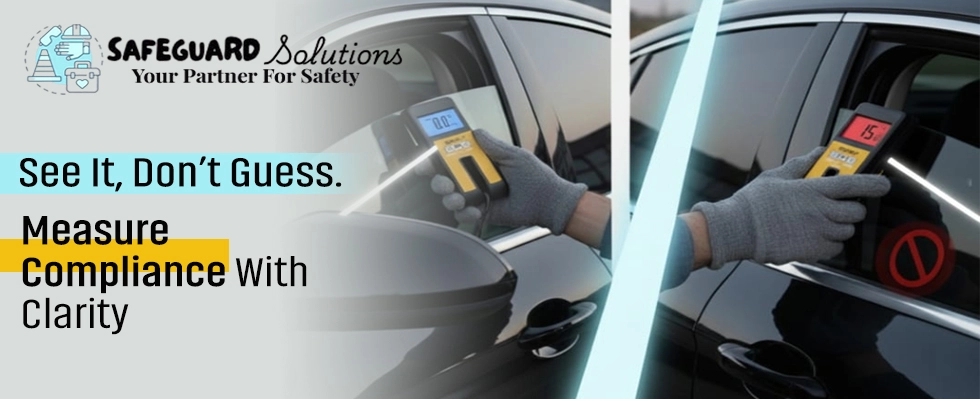
Now you see why window tint meters are so essential these days? If your tint is darker than the specified value, you may have to pay a hefty fine for non-compliance. The tint meter helps you check the VLT of glass panes any time without a single damage to the same. No wonder most of our customers are from the automotive industry!
How Does This Glass Tint Meter Work?
Good question! Let’s explain the process entirely so that you see how simple, non-destructive and efficient it is.
There are actually two forms of tint meters – one-piece and two-piece.
The one-piece devices consist of a single, handheld device that can be slided across the glass edge. Both the light source and the sensor are inside one body. All you have to do is simply slide the device along the glass to get an instant, digital VLT reading.
The two-piece meter has a clamp-like mechanism. You have to place the light transmitting unit on one side of the glass and the receiver on the other. The rest remains the same. This is said to have a high-precision reading, the main reason why it’s preferred by most inspection stations.
The window tint meter that we have in our store is a two-piece model, giving accurate and precise readings at all times.
Most Frequent Applications of Tint Meters
You may be thinking that this simple device only comes into use at car detailing shops or inspection stations. Well, you’re wrong. It’s used in other sectors as well:
- Law Enforcement/RTO Units: The portable tint meters help evaluate a vehicle’s VLT compliance on the road or during a random inspection routine. The fast, digital readings enable transparency checks and enforcements without any damage to the vehicle.
- Building Glass Testing: The solar-control glasses that prevent heat and glare from entering a space are also checked using the glass tint meters. Quality enforcement and inspection officials ensure that the glasses are compliant with the specified regulations without compromising the comfort of the occupants.
- Glass Manufacturing Units Well of course they need to measure the VLT of any glass manufactured to ensure those are in compliance. The glass tint meters make the process easier, effective and less time-consuming, to say the least.
- Architectural and Interior Design: Last but not least, our tint meters help interior designers and architects to calculate daylight penetration and thermal performance of large glass facades. With precise VLT readings, they can select the right materials that balance privacy and compliance.
Key Factors To Consider While Purchasing A Tint Meter
You have gained the knowledge of how these devices work. Now you need to understand what factors influence their performance, because all devices are not the same.
- Range of measurement - make sure that the device is able to measure a full range , from 0-100%.
- Readability and display - A clear, LCD reading even in bright sunlight is essential. Back light features are a plus.
- Accuracy - A +/-3% is okay for workshops and architects. But for inspection stations, +/- 2% is ideal.
- Source of power - Battery-powered devices are the most convenient. See if the device has automatic on/off features to save battery life.
- Certification and calibration - Factory-calibrated certified devices are perfect for use at inspection stations.
Are There Any Maintenance Requirements?
Just the same that you would do for any battery-powered device that has sensors.
- Keep it in a dry, dust-free pouch or bag while storing
- Wipe the sensors with a soft, linen cloth at times
- Don’t keep it near hot surfaces or under direct sunlight
- Make sure you replace the batteries on time
- Reclibrate it every year, if possible, to maintain compliance
Why Choose Our Tint Meter Over Other Options?
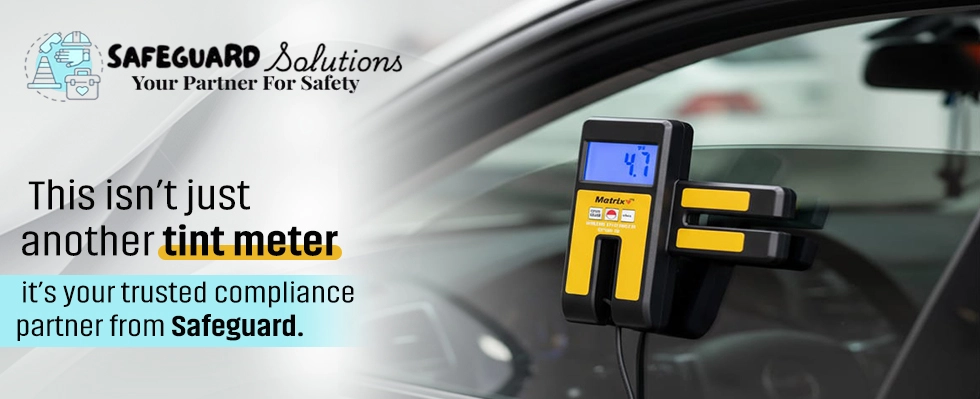
At Safeguard, we supply the Metrix Window Tint Meter to our customers. It’s a two-piece model that gives accurate readings on a digital display.
Why this?
- It measures a complete range of light from 0-100% with +/-2% accuracy
- It works on car windshields, side glass and also laminated panels
- Powered by a standard battery, it also comes with an automatic on/off function
- In about 2 seconds, you can detect the VLT of any glass panel
Automotive service centers, car accessory shops, police inspection units and other sectors can easily measure the VLT of glass with our tint meter.
Safeguard Solutions has a recognition in the industry for choosing only high-efficient testing tools. If you need more assurance, you can always reach our experts. We are here to resolve all your doubts.
Categories
Recent Posts
- Corded Vs Cordless Power Tools For Industrial Applications
- Selecting The Right Hydraulics Tools Supplier For Your Industrial Power Pack
- Buying Guide For Micrometers To Reduce Rework In Industrial Applications
- Manual Vs Digital Window Tint Meter – Which Is More Accurate For Compliance?
- How Fire Suppression Tools Are Transforming Real-Time Protection In 2026


