
Selecting The Right Hydraulics Tools Supplier For Your Industrial Power Pack
Industrial hydraulics is based on controlled, repeatable and engineered force.
Consider the examples of flange management, turbine assembly, structural bolting, and heavy lifting operations. In all these processes, torque accuracy determines safety. In that regard, a hydraulic power pack is not just a pump. It is the control center behind every hydraulic torque wrench, jack, or bolt tensioner in the field.
Selecting the wrong unit can reduce productivity, compromise bolt integrity, and increase downtime risk. Selecting the right one improves efficiency, safety, and compliance.
Let us break this down properly.
Understanding Hydraulic Power Packs in Industrial Applications
A hydraulic power pack converts electrical energy into pressurized hydraulic fluid. That pressurized fluid then drives torque tools and lifting systems.
For industrial torque applications, the benchmark specification is:
- 700 bar operating pressure
- Controlled flow rate around 2.5 L per minute
- 2.2 kW motor capacity
- Portable site friendly design
Why 700 bars? Because most industrial hydraulic torque wrenches are engineered to operate at this maximum pressure. This ensures compatibility across tools used in oil and gas, power generation, and heavy fabrication.
Flow rate determines speed. A balanced 2.5 L per minute ensures steady tool cycling without compromising torque precision.
Motor capacity influences duty cycle. A 2.2 kW motor supports continuous tightening during shutdown schedules without overheating.
Equipment weight impacts technician movement across active sites. A 10 kg portable unit allows technicians to operate across platforms, scaffolding, and confined spaces without logistical constraints.
How To Choose The Right Hydraulic Power Pack?
Selecting a hydraulic power pack should never be reduced to checking a pressure rating in a catalogue. The right choice begins with understanding your application, the torque values involved, and the working conditions on site. Each specification plays a practical role in how the system will perform in the field.
Pressure Requirements
The first step is to determine the torque demand of your application. Larger bolt diameters and higher grade fasteners require greater torque to achieve proper preload. That torque is generated through hydraulic pressure. For most industrial bolting applications, this means working with systems rated up to 700 bar.
The key factor is not just maximum pressure, but consistent pressure delivery. A pump must maintain stable output throughout the tightening cycle. Fluctuations can result in uneven bolt loading, which may compromise flange sealing or structural integrity. In critical environments such as oil and gas or power generation, that margin for error simply does not exist.
Flow Rate and Speed
Flow rate determines how quickly the hydraulic tool operates. A higher flow rate will make the tool cycle faster, which can improve productivity in repetitive applications. However, speed should not come at the expense of control.
In operations such as flange tightening or pressure vessel assembly, controlled movement is essential. A balanced flow rate allows the operator to apply torque smoothly and accurately. This improves precision and reduces physical strain during extended bolting sequences.
Duty Cycle and Motor Capacity
Industrial bolting rarely involves a single fastener. Large shutdown projects often require tightening hundreds of bolts within a defined time frame. In these cases, the pump must be capable of running continuously without overheating or losing performance.
Motor capacity plays a direct role in this reliability. A properly rated motor supports extended operation and ensures consistent pressure output throughout the job. Choosing a pump with inadequate motor power may result in interruptions, slower progress, or premature wear.
Portability for On Site Operations
Real world job sites are not controlled workshop environments. Pumps are often moved between levels, platforms, or confined spaces. During refinery shutdowns or turbine maintenance, equipment needs to be positioned quickly and efficiently.
A compact and portable hydraulic power pack makes this easier. Reduced weight and manageable dimensions help technicians transport and reposition the unit without delaying the workflow. Practical mobility on site translates directly into time savings.
Tool Compatibility
A hydraulic power pack functions as part of a complete system. It must be fully compatible with the tools it is intended to operate. These may include hydraulic torque wrenches, bolt tensioners, hydraulic jacks, pullers, or spreaders.
Most industrial torque tools are designed to operate within standardized 700 bar systems. Selecting a pump that aligns with this standard ensures cross compatibility and allows flexibility across multiple applications. Proper matching between pump and tool prevents pressure loss, protects equipment, and supports accurate and repeatable performance.
In a nutshell, choosing the right hydraulic power pack is a matter of aligning technical specifications with real site demands. When pressure stability, controlled flow, motor reliability, portability, and compatibility are all considered together, the result is a system that performs consistently under industrial conditions.
Applications of Hydraulic Tools in Heavy Industries
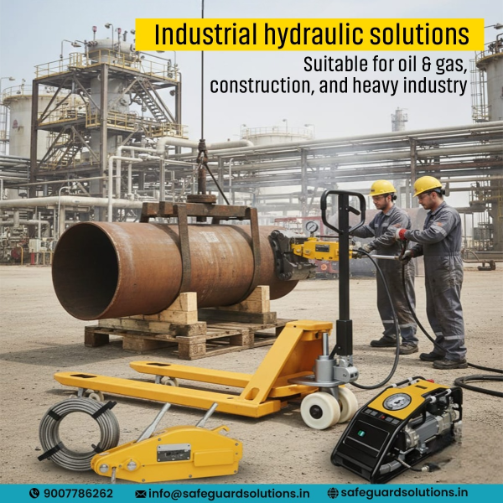
Hydraulic power packs are used across industries where controlled force and precise torque application are critical to operational safety and equipment reliability. From high pressure pipelines to structural steel assemblies, these systems support applications that demand accuracy, consistency, and performance under load.
Below are some of the key industries where hydraulic power packs play an essential role.
Oil and Gas
- Pipeline flange tightening ensures leak proof joints in high pressure pipeline systems where sealing integrity is critical.
- Pressure vessel assembly provides uniform bolt loading to maintain safety and structural stability under extreme internal pressures.
- Shutdown maintenance operations support fast and accurate bolting during time sensitive plant shutdowns where downtime costs are significant.
Power Generation
- Steam turbine bolting delivers precise torque control to maintain alignment and performance in high temperature rotating equipment.
- Generator casing assembly ensures even clamping force to protect internal components and maintain operational reliability.
- Boiler flange maintenance maintains consistent sealing pressure across flange connections exposed to continuous thermal stress.
Construction and Infrastructure
- Structural steel bolting applies controlled torque to critical structural connections that support load bearing frameworks.
- Bridge segment alignment provides accurate fastening to ensure structural balance and long term durability of bridge assemblies.
- Heavy load lifting supplies stable hydraulic force for controlled lifting of large components and equipment.
Heavy Fabrication
- Large diameter bolt tightening generates the high torque required for oversized fasteners used in industrial machinery and assemblies.
- Equipment installation supports accurate bolting during machinery positioning and commissioning activities.
- Maintenance workshops enable reliable and repeatable torque application for routine servicing and overhaul work.
In each of these environments, torque accuracy is not negotiable. Hydraulic power packs deliver controlled, measurable, and repeatable force under high pressure industrial conditions.
How Safeguard Solutions Can Help
When a project depends on accurate torque, the equipment has to work exactly as expected. At Safeguard Solutions, we support clients by taking the time to understand the job before recommending a hydraulic power pack. The focus is always on the application, the torque range involved, and the conditions in which the equipment will be used.
We assist in selecting pumps that match your hydraulic torque wrenches, bolt tensioners, and jacks, ensuring pressure stability and smooth operation throughout the task. This reduces the risk of uneven bolt loading, delays during shutdowns, or unnecessary strain on equipment.
We focus on recommending solutions that make sense for the job at hand, whether it is a refinery shutdown, turbine maintenance, or structural installation. The goal is to ensure that when the pump is switched on, the work moves forward smoothly, safely, and without unnecessary complications.
Categories
Recent Posts
- Corded Vs Cordless Power Tools For Industrial Applications
- Selecting The Right Hydraulics Tools Supplier For Your Industrial Power Pack
- Buying Guide For Micrometers To Reduce Rework In Industrial Applications
- Manual Vs Digital Window Tint Meter – Which Is More Accurate For Compliance?
- How Fire Suppression Tools Are Transforming Real-Time Protection In 2026


