
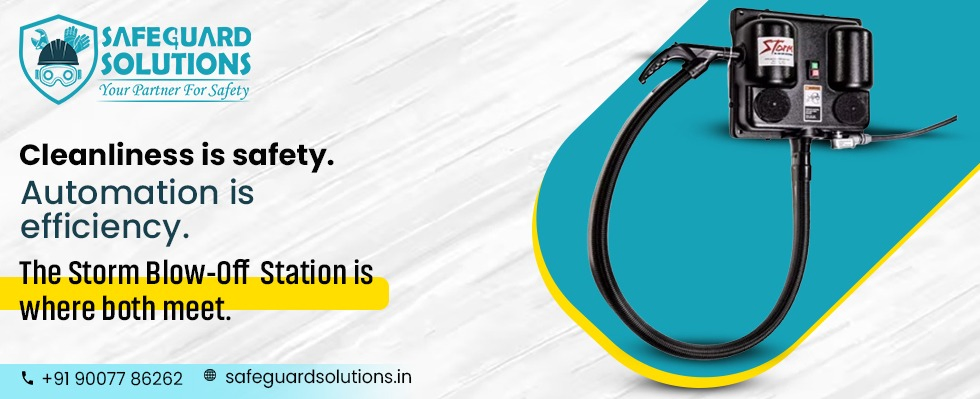
Why The Storm Blow Off Technology Is Gaining Preference For Industrial Cleaning?
With rising concerns regarding safety and energy efficiency in industrial workspaces, traditional cleaning methods are taking a backseat. Brushes and brooms are retiring, and compressed air is getting flagged because of power consumption and safety issues. A more efficient cleaning system that’s now getting recognized widely is the low-pressure, high-volume, blow off cleaning technology.
Safeguard’s Storm blow off station is such a specialised tool that cleans you and your workplace WITHOUT compromising safety.
The industrial cleaning equipment market is expected to reach $14.14 billion by 2031 at a CAGR of 4.3%. One of the biggest reasons for this growth is the development of innovative cleaning technologies in critical settings, like in the electronics, manufacturing, automobile and construction sectors. Workers are constantly demanding solutions that won’t jeopardise their health or safety.
According to The Economic Survey of 2024-25, manufacturing and construction workers, who comprise about 11.4% and 12% of the entire Indian workforce, are majorly experiencing workplace accidents.
However, there are some positive shifts as well. For example, in Telangana, an F&B manufacturing unit was seen to demonstrate a hazard awareness level of about 90% among its workers. It means that workers are now aware of what they need and how they can achieve it.
Going by these observations, the low-pressure air blow-off cleaning technology does fit in perfectly.
What’s Wrong With Traditional Dust Removal Methods?
Let’s leave the clothes and brooms aside and talk about real, industrial cleaning using steam, compressed air, vacuum and suction systems, etc. A certain level of safety risk is associated with each.
- Steam and water cleaning - methods mostly used in F&B manufacturing units pose electrical safety hazards.
- Chemical cleaning solutions - tend to leave residues that when inhaled may increase health risks.
- Vacuum cleaning - comes with regular maintenance obligations for the entire system and its filters.
- Compressed air blow offs - at high pressure may cause debris to flow into the eyes and are also quite energy-intensive.
Using low pressure air (about 2.52 PSI) in high volume for cleaning ensures a reduced level of health and safety risks. Complying with OSHA regulations, the system blasts air on workers’ clothes and workstations, removing dirt, debris and even harmful dry residues.
Step-By-Step Cleaning With Storm Blow Off Stations
First of all it’s 100% safe body cleaning and workplace dust removal tool, ideal for critical industrial settings. The innovative mechanism of blasting high volume air at a low pressure minimises most of the risks associated with other cleaning methods. Let’s explain the procedure in phases for your better understanding.
Step 1: Prepare the setup
The air blow off station that we deliver is highly energy efficient. You need just a 240V, 50Hz power supply to begin with. Plug it in and make sure that the filters are in place. Also see that the air nozzle and hose are also fitted properly. Now when the operating site is clear, just check if the worker, who needs the cleaning, is wearing PPE outfits and a face shield.
Step 2: Ensure safe positioning
To get the best results without compromising safety, ask the worker to stand at a distance of about 0.5 to 1 meter from the nozzle. Next comes operation. Our dust blow off station is available in two operating models –
- Hands-free, with a foot pedal and
- Manual, with a push button
Choose the one that seems the safest and the most convenient option for you.
Step 3: Blow the air to clean
After passing through a filtration system, particle-free, low pressure (2.52 PSI) air rushes out through the motor-driven blower at a high volume (≈58 CFM). These jets of air loosens even stubborn debris on the uniform, exposed body parts, and shoes. While the low pressure air prevents chances of discomfort and skin penetrations, high-volume ensures uniform cleaning. The process lasts for 10-20 seconds per person.
What about the expelled (unclean) air?
Well, it gets channelized into an internal filtration unit. Once the cleaning is complete, the process stops as soon as you remove your feet from the pedal or hand from the switch.
Now, what about removing dust from other places, like conveyor belts, cleanrooms, machine housings or work tables?
The entire process remains the same, like cleaning surrounding areas and adjusting the distance between the target and the nozzle. For best results, keep it at 10-20 cm approximately, and push the pedal to blow air. In case the area to be cleaned is quite narrow, make sure you adjust the nozzle angle accordingly.
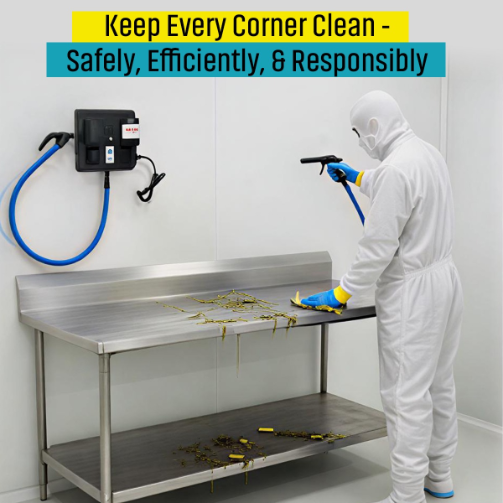
Efficient Cleaning With No Safety Hazard
Our low-pressure air blow off body cleaning station saves an impressive amount of energy compared to air guns and other traditional tools. We guarantee you that it saves more than 90% of energy costs during its lifespan. Additionally, it poses no safety hazard and keeps both workers and surfaces clean and comfortable.
In a nutshell, you’ll get a static control device that’s OSHA-compliant, energy-efficient, easy-to-use and designed to maintain the highest standards of industrial safety.
To quote Mr. Inam Murad, our partner and CEO, “Safety and efficiency are no longer two separate requirements for cleaning. In today’s industrial landscape, these are the design defaults in any system.”
All our industrial tools and equipment follow this essential principle. While efficiency is somewhat expected, we try to NEVER compromise safety while delivering engineered solutions for your project.
Feel free to share other relevant concerns or queries about our storm blow off station. If required, we can discuss project-specific information with you via –
Categories
Recent Posts
- Corded Vs Cordless Power Tools For Industrial Applications
- Selecting The Right Hydraulics Tools Supplier For Your Industrial Power Pack
- Buying Guide For Micrometers To Reduce Rework In Industrial Applications
- Manual Vs Digital Window Tint Meter – Which Is More Accurate For Compliance?
- How Fire Suppression Tools Are Transforming Real-Time Protection In 2026


