
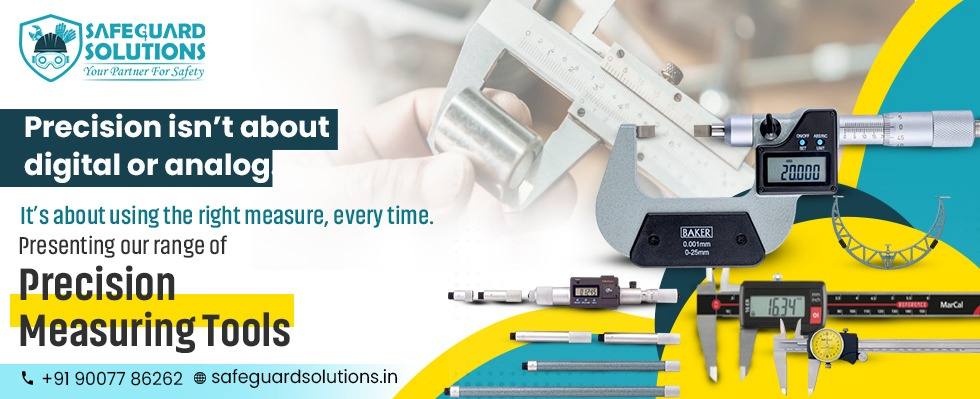
Will Digital Precision Measuring Tools Replace Analog Ones In 2026?
To answer this question in short, it’s not about ‘replacing’ anymore. It’s about optimising existing practices with new upgrades.
Although rumors across multiple production platforms say that analog tools, like vernier calipers and mechanical micrometers, are getting outdated, the reality is different. Today’s manufacturers are far more interested in understanding which type of measuring tool gives better control over quality, consistency, and decisions in real conditions. They are not driven by trends or tradition but production efficiency.
And both analog and digital tools that optimize efficiency fall in that preference category.
At Safeguard Solutions, we try to align our curated range of products strictly according to manufacturers’ preferences. Our range of Baker’s precision measuring tools are simply the best, irrespective of digital or analog functionalities.
Dial Vernier Calipers in Daily Measurement Tasks
These remain one of the most reliable tools on the shop floor. By measuring internal and external dimensions quickly, they are almost indispensable during setup, process checks, and verification.
The dial vernier caliper offers clear advantages in durability and readability. With a measurement range of 0 to 200 mm and a resolution of 0.02 mm, it delivers accuracy without relying on electronics. The easy-to-read dial scale allows operators to interpret readings quickly, even in adverse conditions, like low light conditions. Further, the hardened steel measuring jaws, and a tough frame ensure long-term reliability in industrial settings.
In practice, dial calipers are often preferred when operators need immediate visual feedback and mechanical confidence, particularly in workshops and labs where tools are used continuously throughout long shifts.
Micrometers for Precision Control
When tolerance requirements exceed what calipers can reliably handle, micrometers come into play. The standard micrometers are designed for accurate internal and external measurement of small components, where even minimal deviation can affect performance or assembly.
With a measurement range from 25 mm to 300 mm and a resolution of 0.001 mm, these precision measuring tools find extensive uses in machining, engineering, and quality control applications. Hardened steel anvils and spindles ensure wear resistance, while finely graduated threads allow controlled and repeatable adjustments. Features such as spindle locks and non-slip grip handles help maintain consistent pressure during measurement.
Whether used in analog or digital form, micrometers are trusted for repeatable tasks that require confidence and accuracy.
Large Micrometers for Oversized Components
Standard micrometers have limits, especially when dealing with thick materials or large components. In those cases, large micrometers fill the gap.
With measurement ranges extending from 75 mm up to 1000 mm and a resolution of 0.01 mm, large micrometers are used in industries such as automotive, aerospace, and construction. These offer stability while measuring pipes, plates, or structural components. Further, the spindles and anvils maintain accuracy across extended ranges.
Available in both digital and mechanical options, large micrometers are typically selected based on inspection needs. Mechanical versions are often used during setup and alignment, while digital versions are preferred when measurements must be recorded or shared across teams.
Inside Micrometers and Internal Measurement Accuracy
Internal dimensions are among the most challenging features to measure accurately. Designed specifically for measuring holes, bores, and cylindrical features, the inside micrometers work effectively especially where calipers may introduce alignment error.
These tools feature a measurement range of 25 mm to 150 mm and a resolution of 0.01 mm. Instead of buying separate tools for different bore sizes, the operator can easily change the rod length to match the approximate size being measured, and then fine-tune the measurement using the micrometer screw.
The inside micrometers are essential in toolrooms and quality control labs where internal dimensions directly affect fit, vibration, and service life.
How Efficient Are Digital Vernier Calipers?
Now, one of the most common upgrades in measurement workflows is the digital vernier calipers. By combining traditional vernier functionality with a digital display, these tools reduce reading errors and speed up repetitive measurement tasks.
With a measurement range of 0 to 150 mm and a resolution of 0.01 mm, the digital vernier calipers can handle internal, external, depth, step, and inside diameter measurements with ease. The large digital display removes the need to interpret scales, making them especially useful in inspection environments with multiple operators. Further, the stainless steel construction ensures durability despite frequent handling.
In 2026, digital calipers are widely used where measurements must be documented, shared, or audited, particularly in quality control and inspection stages.

Digital vs Analog in Real Production Conditions
So, the question if digital tools will replace analog ones in 2026 is actually invalid. Any tool that ensures accuracy of measurement, consistency in diverse environments and purpose will never grow outdated, if you ask us.
For example, analog tools like dial vernier calipers and mechanical micrometers will continue to dominate setup and troubleshooting tasks, whereas digital tools will excel in inspection workflows, where speed, readability, and traceability are critical.
Rather than choosing one over the other, manufacturers are now assigning different roles to each, and this trend will continue in the coming days. While analog precision measuring instruments establish confidence at the machine level, digital tools reinforce that confidence through documentation and process control.
In 2026 and beyond, it’s better to invest in precision measuring instruments because of their efficiency in the measurement job you’re involved in. It can be digital or analog, doesn’t matter as long as it’s being applied the right way and in the right task.
Categories
Recent Posts
- Corded Vs Cordless Power Tools For Industrial Applications
- Selecting The Right Hydraulics Tools Supplier For Your Industrial Power Pack
- Buying Guide For Micrometers To Reduce Rework In Industrial Applications
- Manual Vs Digital Window Tint Meter – Which Is More Accurate For Compliance?
- How Fire Suppression Tools Are Transforming Real-Time Protection In 2026


